Will Eisner (editor, script, pencils, inks)
Joe Kubert (colors)
Sam Rosen (letters)
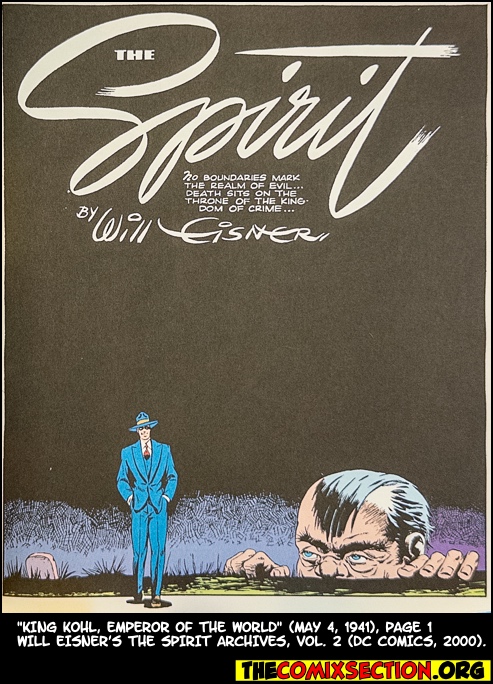
In terms of narrative flexing, King Kohl doesn’t try much. Kohl’s big idea is to use his gang’s criminal might to rob the Central City arsenal and use those weapons to take over the underworld. Kohl’s just out of a year in stir, where he’d been reading of a certain—finally named in the strip—whiny cishet Austrian white man’s perceived struggles. Now, Kohl figures, it’s time to enact a similar plan in the United States.
“But, Boss,” says one of the gang, “what about the Spirit?”
But, King Kohl is no Republic movie serial villain—he’s had the Spirit captured the whole time! Except he hasn’t because the Spirit escaped at some point during Kohl’s villain monologue, even having enough time to tie up his now unconscious guards.
Spirit heads straight to Commissioner Dolan, who’s heading home at midnight, weary from the day. Dolan thinks the Spirit is pulling his leg. Once again, Eisner and studio have no idea what to do with this relationship. It’s been paternal, it’s been sincere, occasionally even tender, but Kohl’s going to have Dolan doing a bait and switch. Spirit thinks he’s not getting any help, so he goes it alone. Dolan then calls in the report, but he wants to be the hero, so he takes only two police units. The petty adversarial stuff could be funny—especially since Spirit and Ellen Dolan are definitely smooching in front of her dad on occasion—but the professional incompetence stuff is a flop.
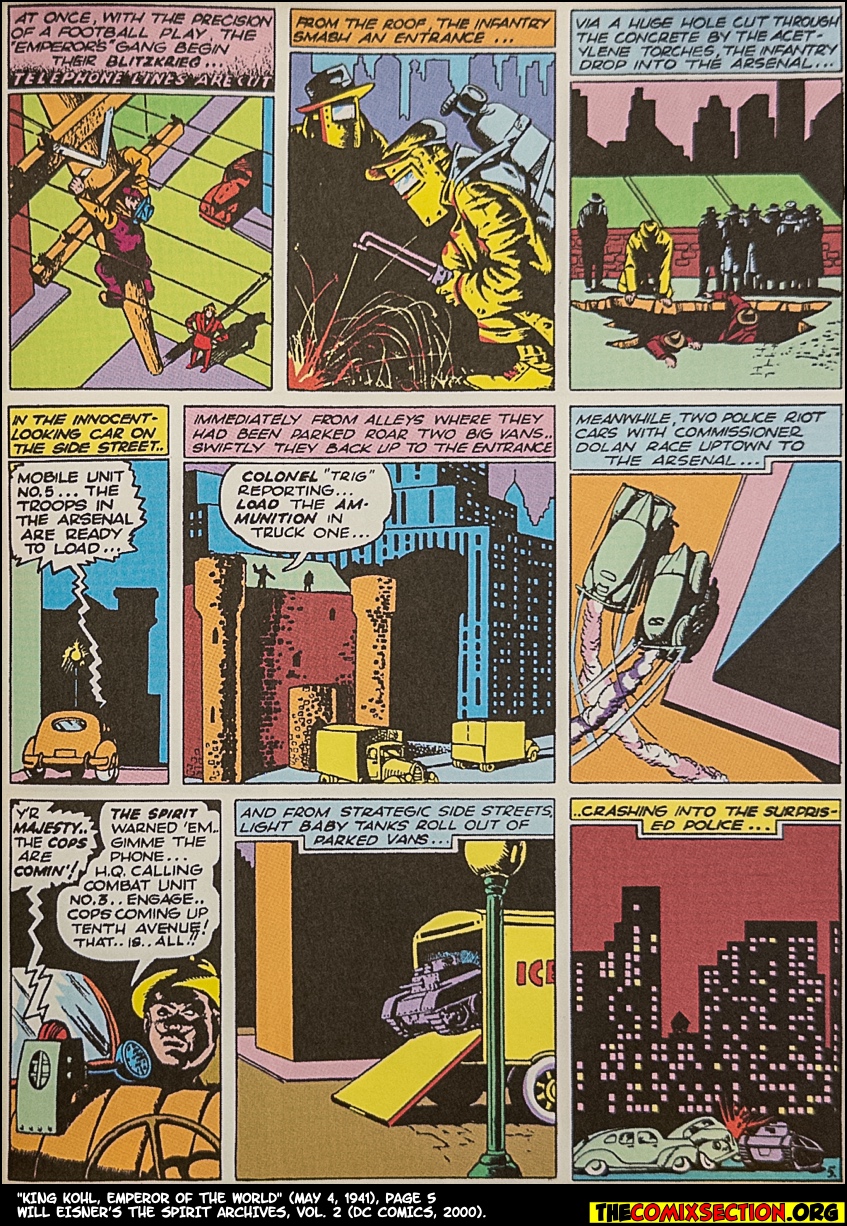
Instead of intercepting Kohl’s outfit in time, Dolan gets there after they’ve had time to set up. The setup includes baby tanks and armed aircraft. What Kohl needs from the Arsenal is unclear, given the tanks, of course. While they never fire, only crash and crush, the airplane is using its guns. It is spring 1941, after all; you can just buy tanks and military aircraft from your local armaments company. They’ve been making tons of the stuff.
Luckily, the heist, and Spirit and Ebony’s foiling of the getaway are such a visual delight, the strip doesn’t need the narrative to be sensical. Or maybe it’s just seeing the autoplane in action, doing seemingly aeronautically impossible stunts, Ebony non-lethally taking out the crooks, willful transcends to gleeful in terms of disbelief suspension. It’s kind of strange—Spirit and Ebony as action heroes—and the militarization of the Cagney-esque gangster, along with the dangers of fascism undercurrent… It’s a very spring 1941 strip.
And then the ending has Spirit and Ebony leaving baddies hanging from the streetlights, a la Wayne, Grayson, Parker, et al. Well, earlier than Parker but at least contemporaneous with Wayne and Grayson.
Now, I kept forgetting to mention—Dolan and Spirit seemingly don’t remember The Black Queen’s Army when someone tried to take over New York City (when the strip was set there) with a similarly militarized, organized crime force. One wonders if Eisner and studio remembered.
So, again, not the most innovative or original of Spirit, but really darn good.
 The Stop Button
Leave a Reply