
Will Eisner (editor, script, pencils, inks)
Joe Kubert (colors)
Sam Rosen (letters)
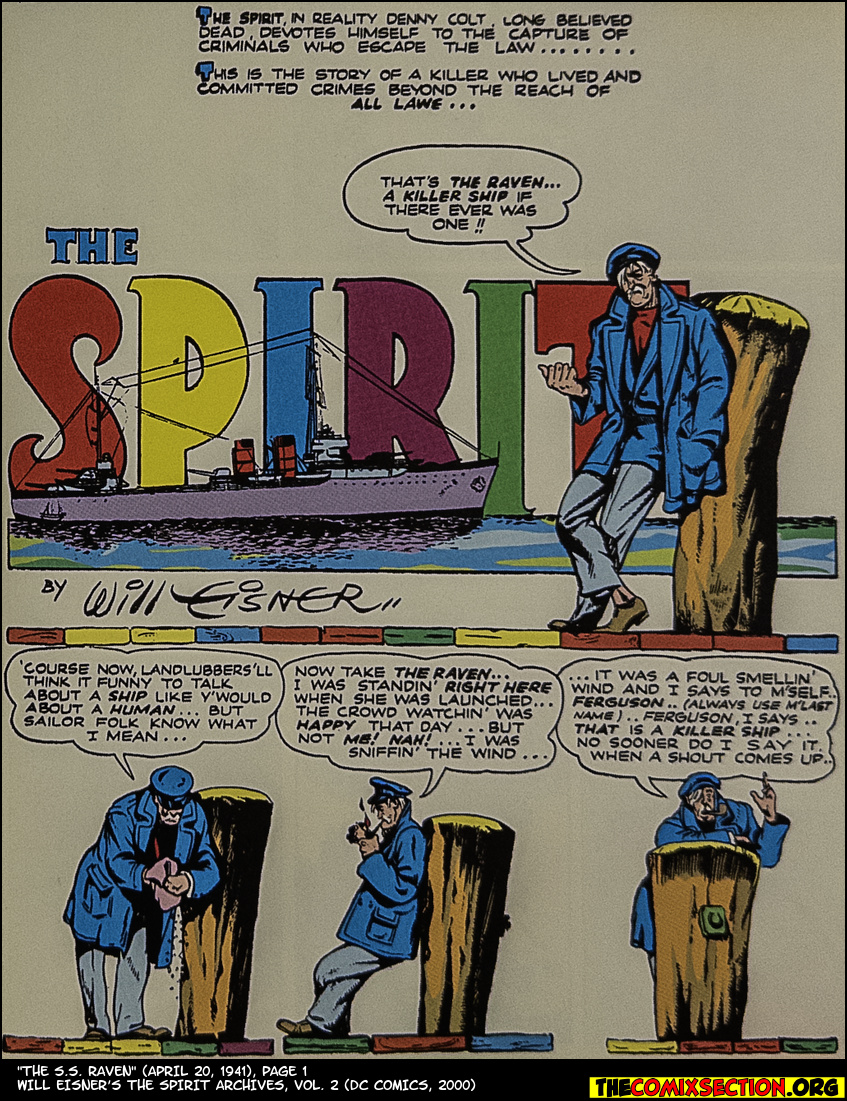
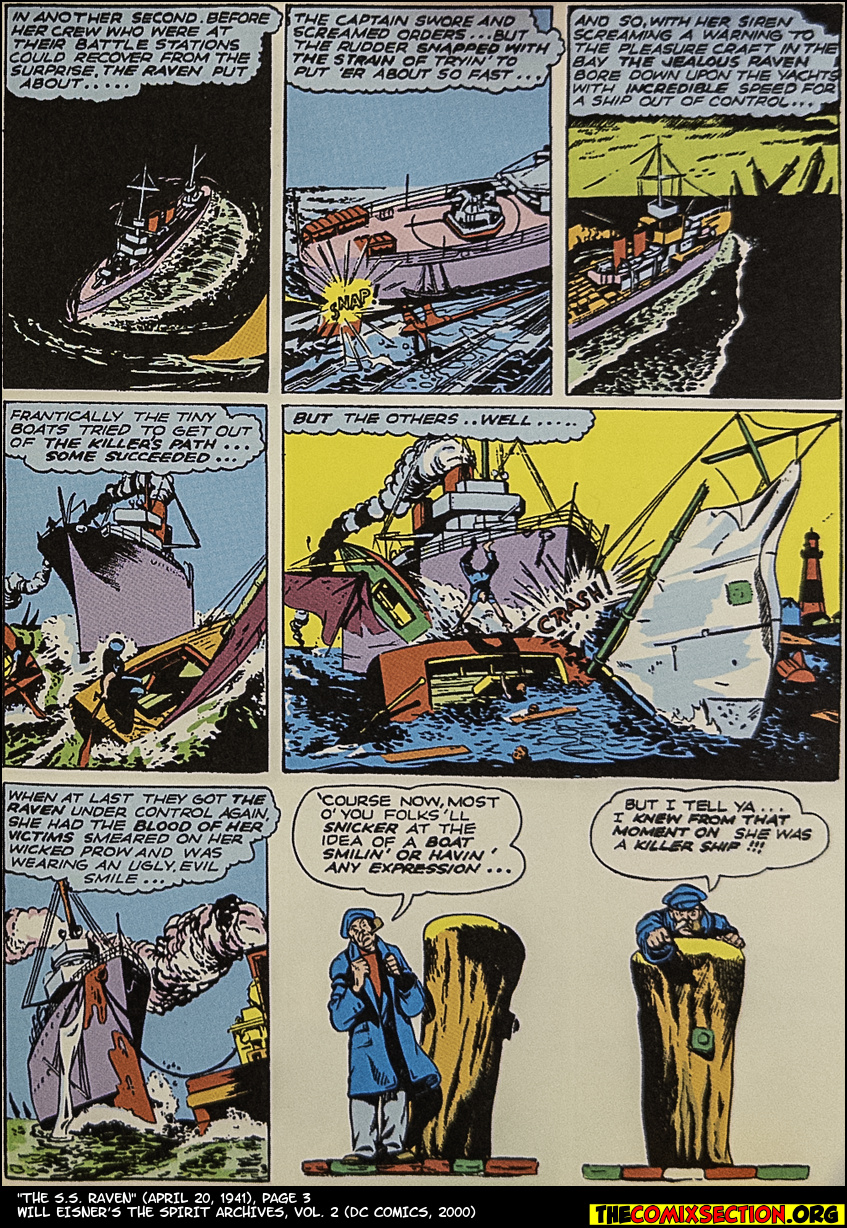
The Spirit has had a wider narrative scope as of late, but never before have Eisner and studio attempted anything like S.S. Raven. It’s a phenomenally weird strip, all about a killer Navy boat, with an ornery, lovable sea captain narrating the tale from a dock. The story focuses on the ship’s murderous nature, with the captain—Ferguson—laying on the purple prose, always leaving just enough room to think about the ship’s body count without the assigned agency.
From that point of view, the Raven’s been in some extraordinarily unlucky circumstances–being captained by a series of failures couldn’t have helped. From Ferguson’s narrative stance, however, they weren’t so much failures but the Raven’s annual victim. All of the ship’s captains, whether in the ship’s U.S. Navy days, its subsequent time in an unnamed South American country’s navy, and—well, no spoilers—but all of the captains do die within a year of taking command. Very unlucky circumstances. But a murderous, petty, vengeful boat?
Then, around the fifth page, Ferguson reminds the readers they’re reading The Spirit. Spirit is chasing the bad guys onto their getaway boat, which just happens to be the Raven, now in the ownership of a master criminal. Until this point, the strip’s been either Ferguson telling scary stories from the dock or the Raven’s murderous impulses and impacts summarized in long shots. Now, we get intense fisticuffs onboard, an autoplane sequence for (an otherwise off-page) Ebony, some derring-do from Spirit, and a final punchline. The fisticuffs sequence is excellent, leading into Spirit’s realization of the ship’s malevolent nature (according to Ferguson, anyway; it could just be Spirit pays attention), which resolves with moody suspense, before going into high-flying action, which also has a bit of a tone shift finish. It’s a constantly moving, constantly evolving action strip. It’s glorious.
And that glorious visual pace and the ever-building momentum enable the strip’s particular narrative device to succeed. If S.S. Raven were Ferguson—jovially and affably–telling the story without the visuals being dynamite, the strip simply wouldn’t work. What then stands out is the assuredness of Eisner and studio’s work here. It’s a relatively big swing for the strip, but there’s never a moment where it isn’t connecting. If it were a backdoor pilot for a “haunted ships of the Navy” strip, I can’t imagine that strip not getting the green light. It’s great big boat action, then it’s great Spirit action, and so on.
In addition to being outstanding, Raven’s also in that still small group of strips where Spirit doesn’t show until page five. The strip’s getting a lot more comfortable with the broader narrative scope, but it still hasn’t let Spirit go entirely. And, if this strip’s any indication, Eisner’s going to make sure the Spirit gets a strong set piece, but the strip’s on an established trajectory, now. The Spirit might not always have to be about the Spirit.

 The Stop Button
Leave a Reply