Will Eisner (editor, script, pencils, inks)
Joe Kubert (colors)
Sam Rosen (letters)
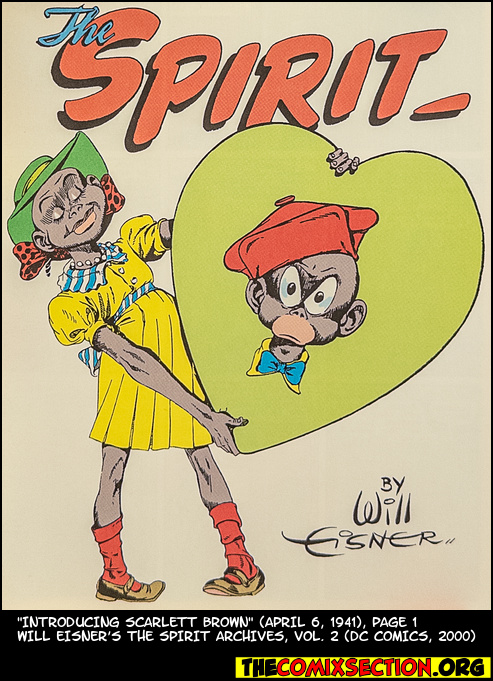
If you want to explore the peculiarities of Spirit’s characterization and visualization of Ebony White, Introducing Scarlett Brown is probably the most fodder the strip’s seen to date.
Ebony, of course, is the Spirit’s only confidant, best friend, assistant investigator, and occasional savior. Ebony’s single-handedly saved Spirit’s bacon at least two times, probably three. Eisner and studio just happen to draw him Sambo-style and write his dialogue like it’s Amos ‘n’ Andy. Save his second (or third) strip, Ebony has been the only Black character in The Spirit. And that other time it was about the lodge hall (in a visual Amos ’n’ Andy style).
As the book says, yikes on bikes.
This strip introduces Ebony’s love interest, Scarlett, a Black girl who’s dressed like she’s a tween. Spirit met Ebony when Ebony was a cabbie. Now, the strip took place in New York City at that time, and, at that time in 1940, the driving age was eighteen in New York City–sixteen or seventeen with a learner’s permit. Even assuming Ebony’s fourteen…
Not great stuff. Also not great is Scarlett and Ebony’s rival for her affections, the imposingly named Throckmorton, who is also in Sampo style. But then, inexplicably and welcome, Mr. Brown is, you know, just a guy. Like, he’s not the best rendered character in his one medium shot before he’s narrating a flashback, but he’s just a Black dad guy. It’s fine.
Also, his dialogue is fine, no minstrel dialect. And racism doesn’t appear to exist in The Spirit. The strip has been racist—Black people, Mexican people—but none of the characters have ever exhibited any prejudice towards those characters. The creatives are mocking them for the readership.
And that part is actually the worst. Maybe. Because other than the racist caricature and dialect, Ebony’s a great character. As long as he’s twelve because he wins Scarlett in a “game o’ marbles.” Spirit’s surprised about the marble thing—after observing his lovestruck friend with sincere happiness–which also has some vibes. Though without the visuals, the strip would be a lot closer to it being tweenage folly.
Post acquisition, Ebony goes to see Scarlett and finds Throckmorton already there. Mr. Brown wants to meet both boys (the marbles go unmentioned). Except it turns out Scarlett really wants Ebony to talk to her dad about work stuff: spies have been snooping at his munitions factory. And Ebony’s been over-hyping himself—he’s told Scarlett and Throckmorton he’s the great detective and Spirit’s his assistant.
So while Throckmorton takes Scarlett for an ice cream, Ebony gets the lowdown on the case. It’s simple enough work, especially for the Spirit, but Spirit decides to make Ebony do all the work himself because of the lying.
Until things get violent, Ebony’s doing a great job on his solo mission (not his first; he’s saved the day in multiple strips). He investigates the crime scene, finds additional clues, pursues those leads; he’s got a moral purpose (though his courage is from Scarlett’s renewed affection at his acceptance of the case). It’s a great strip for Ebony.
Despite the visuals and dialect. The dialogue’s probably great if cleaned up. It’s infuriating.
Spirit maintains a presence, which works out (and also lends to the niceness). There are some excellent panels, if not full pages. Some fine action beats. Some of them even manage to be racist in how they visualize Ebony fighting in a darkened room. If it weren’t being racist, it’d be a fine strip.
Swell.
But then it’s even worse when you remember Spirit’s a weekly newspaper strip. And it’s so messed up to make a role model character into a racist insult directed at the audience the character should be representing.
So long as when the strip retconned from New York City to Central City, Ebony de-aged to twelve or so. Because if he didn’t, it’s an even bigger layer of f**ked up.

 The Stop Button
Leave a Reply