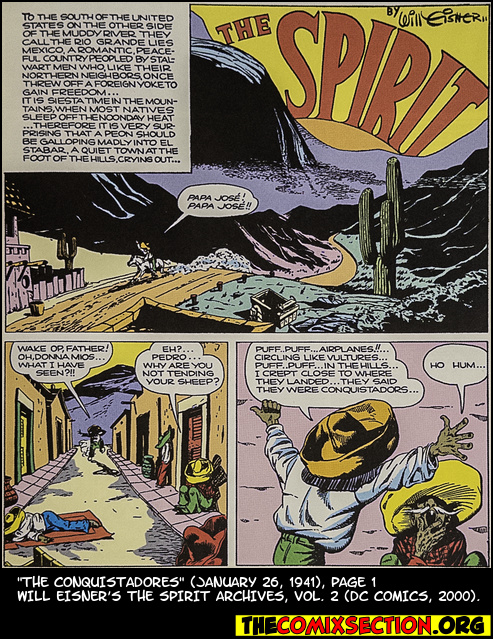
The strip takes place in Mexico, where the Spirit foils an attempt by some treasonous Mexican army folks to side with foreign powers to overthrow the government. The foreign powers are presumably German, but Eisner’s still not being specific.
But Spirit doesn’t show up until page three, with the strip opening instead on a young man named Pedro arriving in town to tell everyone about enemy aircraft. No one believes him, so he keeps trying; the sequence gives Eisner and studio the chance to do some slice-of-life panels for the village. Lots of good little panels establish the setting before the action turns to the villains.
Using their silent bombs, the bad guys take out a different village, which is explained in the expository text, but, visually, it seems like it’s the opening village. These silent bombs do all the damage and exploding of regular bombs, only with no sound whatsoever. All of a sudden, Spirit’s flying car becomes a lot less far-fetched.
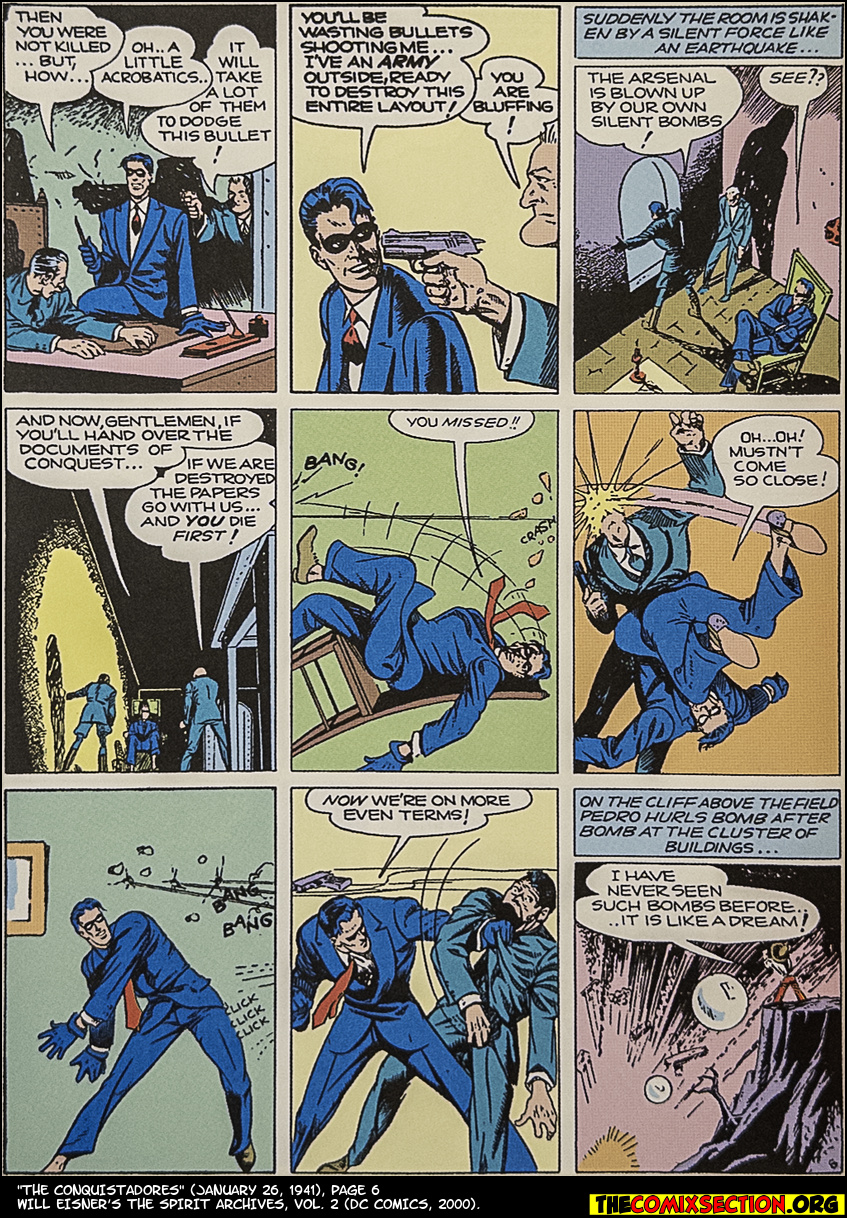
The Spirit arrives and tries to take on the baddies himself, only to get captured and dropped out of a flying plane. Luckily, he’s got those gymnastics skills and is able to save himself; he then comes across Pedro and enlists him in the effort.
There’s a somewhat complex setup involving Pedro using the silent bombs against their makers while Spirit goes in for the direct approach. The last few pages have some wonderful art, whether Spirit’s fisticuffs or the bad guys walking around the ensuing wreckage.
The strip feels a little forced with its politics, and, despite the villains being indistinct, spends a lot of time with them. Spirit’s never really the protagonist (it’s either Pedro or the bad guys running scenes); he’s presumably in Mexico on assignment from the U.S. government. It’s never clarified. Missed opportunity for a very humorous scene of Spirit gassing up the autoplane for his approximately two-thousand-mile trip.
Eisner’s characterization of Mexico has the accent and portrays all of the villagers as so layabout they literally do nothing but layabout, while also putting Mexico as comparable to the United States as both countries threw off the imperial yoke. A 1941 version of ahistorical good vibes.
The art, action, and timing make up for the rockier bits.
 The Stop Button
Leave a Reply