Will Eisner (editor, script, pencils, inks)
Joe Kubert (colors)
Zoltan Szenics (letters)
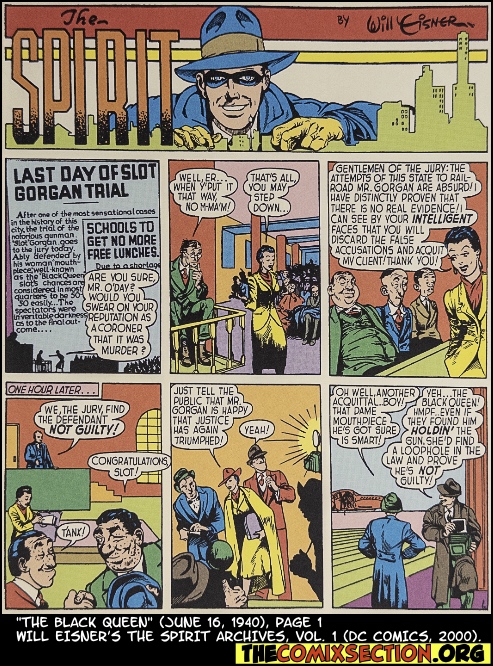
The first panel sets up everything in the strip (save formal cast additions)—mobster Grogan on trial for murder, defended by “The Black Queen,” his lawyer, and a side item about the school district running out of money for lunches.
Grogan gets off (with implications of a fixed jury), and Spirit drops by to ask him for a donation to the school lunches. Now, Spirit has just interrupted Grogan and Black Queen talking business… she’s more than his lawyer, it’s her mob and he’s her proxy. Spirit either just missed that disclosure upon sneaking in, or he was too distracted, or he didn’t think it warranted comment.
He will go out of his way to get a look at Black Queen in her undergarments because the strip’s got a lot of implied misogyny. Can’t trust dame lawyers.
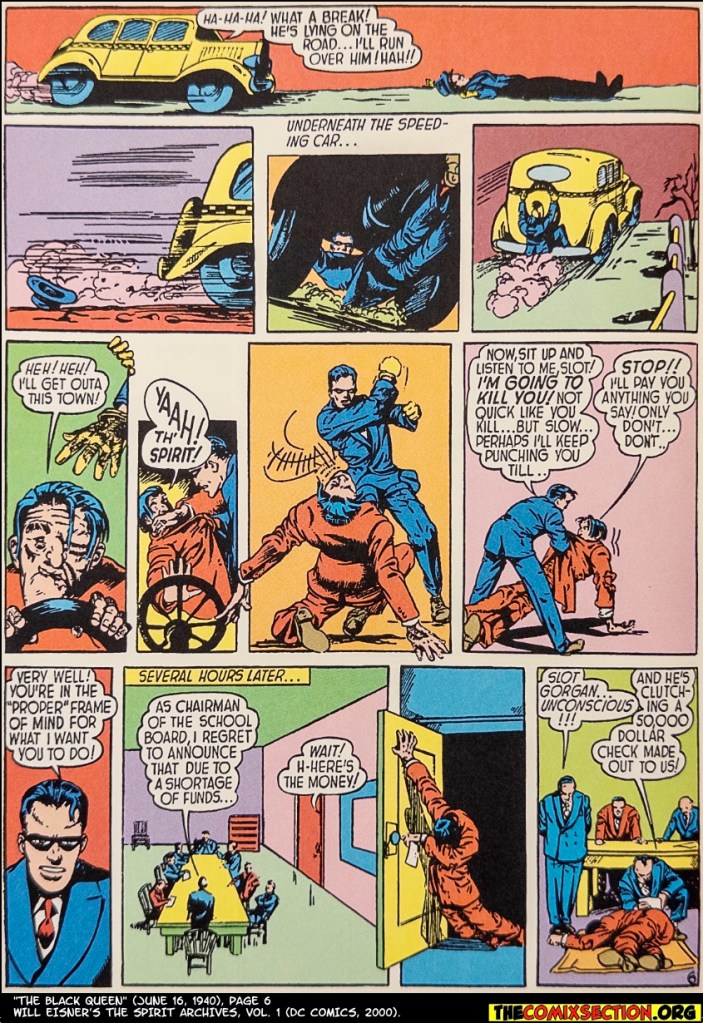
Also, let’s get this one done, too—Ebony gets his full name and hired on as Spirit’s sidekick. His assignment goes from being a cabbie to holding a gun on the coroner, the district attorney, Grogan, and Black Queen. For a criminologist, Spirit has a profoundly confusing understanding of the criminal justice system. Perhaps they’re in a universe without double jeopardy, in which case Spirit’s plan isn’t to torture and extort Grogan, or they are in a universe with double jeopardy and it is Spirit’s plan to torture and extort him.
It’s strange either way, and the action all seems toned down. Lots of longer scenes to get out dialogue, normal length chase scenes. There’s still some lovely composition, but it plays like the opening newspaper headings exposition device is the strip’s most significant success and, upon making the hit, Eisner and studio coasted a bit.
The last panel has Spirit and Ebony heading to the Wildwood Cemetery—where Denny Colt was buried in the first strip and Spirit’s been hiding out since (doesn’t he miss plumbing?)—and the moment’s from Ebony’s perspective. They have a little banter and… well, the Spirit’s a weird dude.
Maybe on purpose, maybe not. Even as the dialogue and exposition improve this strip—Eisner (or whoever) realized the art doesn’t need a lot of words slowing it down—the Spirit gets a little more distant. Eisner hasn’t decided how to position the reader with the Spirit yet. This strip tries some things, but doesn’t have room to evaluate them.
 The Stop Button
Leave a Reply