Will Eisner (editor, script, pencils, inks)
Joe Kubert (colors)
Zoltan Szenics (letters)
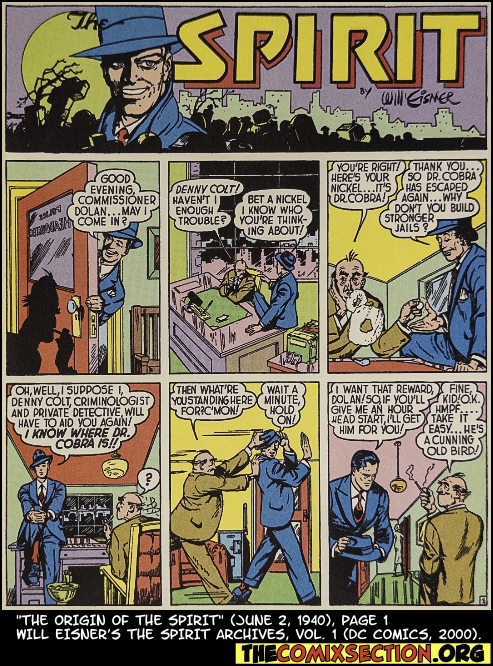
The Spirit ends his first adventure leaving three burning questions unanswered. First, why is he remaining officially dead—we’ll loop back—second, why doesn’t he think everyone will recognize his blue suit, and, third, how does he have those little tombstone calling cards carved already.
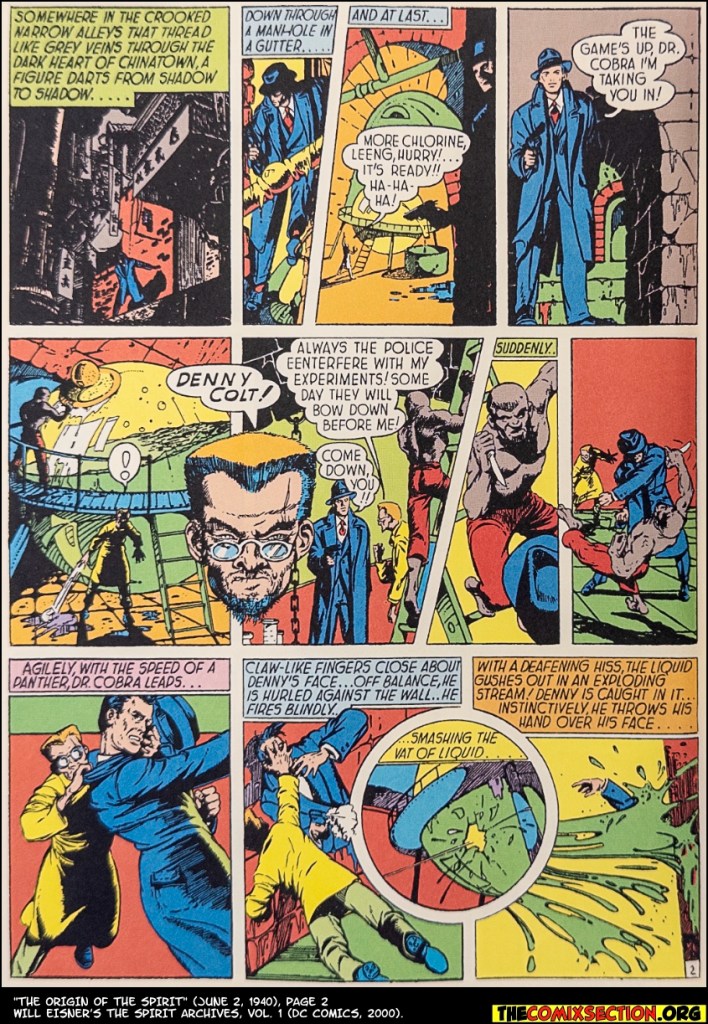
The strip—Spirit dropped as a weekly newspaper special—has thirties illustration sensibilities, almost PG-13 dialogue (as newspaper audiences include more teens and adults than a regular comic book), and sublime stage direction. Eisner doesn’t waste any panels, big or small (the Spirit’s resurrection is in extreme long shot in a small panel), but also saves some composition wows for the third act. Sure, Spirit is fighting escaped criminally insane Eastern European mad scientists with racist caricature henchmen, but the visuals of the showdown are pure noir (Technicolor noir?) fisticuffs. It’s hard boiled hero stuff, even as the Spirit—despite being in it, at this point, for the money and not having to pay taxes—is a bit of a lug, especially for a vigilante.
This first strip introduces the Spirit (Denny Colt before death, just “The Spirit” after), police commissioner Dolan (who knows the Spirit’s identity and approves of that plan to be a vigilante), and, in a one panel cameo, Spirit’s future sidekick, Ebony White. Ebony’s a cabbie; he doesn’t get a name here. Ebony’s a young Black man. The caricature is horrific. The villain—Dr. Cobra—has the Asian bruiser sidekick and it’s a bit. Ebony’s a lot.
And it’s just a panel (albeit observed with foreknowledge). But imagine how big a panel on the newsprint. Spirit’s greatest boon—being read with more potential detail—also can spotlight its unfortunates.
Bad, worse, good, mid, sublime, inspired, and genius—The Spirit has them all. Eisner (and his studio) deliver a visually compelling, narratively engaging comic spectacle. The exposition ranges from flat to purple, but the movement—and the movement’s framing—is truly exceptional work.
Even if the exposition doesn’t help, there are smarts to the plotting. For example, the two best visual sequences are Spirit’s showdowns with Cobra. He’s either had a jovial or moody setup for the showdown, then Eisner delivers the action goods. Vats of chemicals, henchmen, escape boats in the backgrounds and foregrounds, big and small parts of the action, and full of deeper implication. It’s mood implication, though, not exposited.
Anyway.
The Spirit’s off to a great start. Just hold onto your (blue) hat on the proverbial cab ride.
 The Stop Button
Leave a Reply