Tag Archives: James Earl Jones

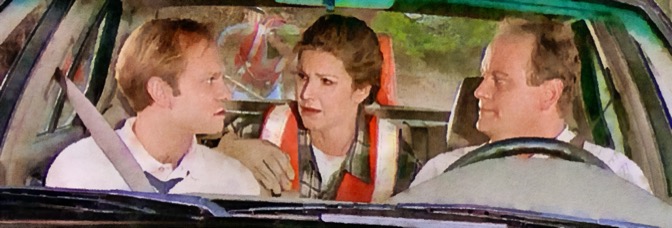
The Ambulance (1990, Larry Cohen)

How can Cohen do such amazing New York location shooting, but not be able to direct whatsoever? His composition is a disaster, but so is every dolly and pan. Luckily, his script is decent and his cast is phenomenal. So, even with the direction, The Ambulance is outstanding.

While Cohen’s dialogue is occasionally a tad tepid, his plotting is unbelievably tight. He introduces characters in the natural flow of the story, never worrying late additions may be hostile to the audience.

The film has a bunch of fantastic performances but the two most important are Eric Roberts (as the lead) and Megan Gallagher (as his reluctant sidekick). Roberts maintains energy and enthusiasm throughout—every moment he’s on screen, he’s captivating. Even with a terrible haircut.

Half Gallagher’s performance is unspoken, just her expressions changing. She has great chemistry with Roberts.

Red Buttons has a nice part—excellent chemistry between him and Roberts. It’s too bad there wasn’t a sequel, given he gets along with Gallagher well too.

James Earl Jones also has a good part. He has a lot of fun. The next supporting tier is strong too. Janine Turner, Eric Braeden, Richard Bright, all good. Stan Lee has a nice cameo for realism’s sake (Roberts works at Marvel Comics).

The only bad performance is Jill Gatsby’s and the only bad technical aspect (besides the direction) is Jay Chattaway’s awful score.

I wasn’t expecting anything from The Ambulance; turns out it’s quite good. Roberts and Gallagher make it occasionally amazing.

CREDITS

Written and directed by Larry Cohen; director of photography, Jacques Haitkin; edited by Claudia Finkle and Armond Lebowitz; music by Jay Chattaway; production designer, Lester Cohen; produced by Moctesuma Esparza and Robert Katz; released by Triumph Films.

Starring Eric Roberts (Josh Baker), James Earl Jones (Lt. Spencer), Megan Gallagher (Sandra Malloy), Red Buttons (Elias Zacharai), Janine Turner (Cheryl), Eric Braeden (The Doctor), Richard Bright (McClosky), James Dixon (Detective Ryan), Jill Gatsby (Jerilyn) and Stan Lee (Marvel Comics Editor).


Related posts:

About these ads

Conan the Barbarian (1982, John Milius)

John Milius takes Conan the Barbarian very seriously. The occasional use of slow motion and the endlessness of Basil Poledouris’s cheesy score signal Milius’s dedication. So do the long and frequent sequences of shirtless Arnold Schwarzenegger playing with big swords. At the beginning of the film, when it’s the prologue and Milius strange approach actually feels like the 1970s maverick (or friend of the mavericks) making a movie with James Earl Jones in a wig, it’s okay. Milius’s commitment there, it’s misguided and silly, but it isn’t idiotic.

Shortly after Schwarzenegger shows up, it gets idiotic. There are probably ten reasonable minutes (or seven) with Schwarzenegger. Then it gets to be too much. Schwarzenegger, obviously, cannot deliver dialogue (so when Milius gives him a couple monologues at the end, when the film’s already causing bleeding from the eye and mass suicide among brain cells, it’s astounding), but he can’t even emote properly. Had any of Schwarzenegger’s opponents for governor just run clips from this film… I can’t believe he would have won. It’s almost cruel how Milius uses him.

Then the rest of the cast shows up–near as I can tell, Jones was solely cast for his name recognition and to deliver a “my son” line straight out of Empire–and it just gets worse. Sandahl Bergman gets most of the lines–her frequent cooing at Schwarzenegger is icky as opposed to romantic–and she’s awful. She’s probably better than Schwarzenegger, who really doesn’t have much dialogue (it probably all fit on a page… half a page if the repeated lines are removed), but it isn’t saying much. In some ways, she doesn’t embarrass herself because she’s not a real actor, like Jones. However, Mako does embarrass himself. Max von Sydow, on the other hand, does not. He’s only got one scene–most of his dialogue is in one shot–and he’s in a big goofy costume. I didn’t even recognize him.

Ben Davidson and Sven-Ole Thorsen, as the two secondary bad guys, are worse, acting-wise, than even Schwarzenegger.

The production’s all very ornate (even if the special effects are out of a TV movie) and somewhat impressive. But Milius’s script is just dumb. Bergman’s character’s never even named in dialogue. Milius didn’t stick much to the Robert E. Howard library except for some details–Jones’s villain is nothing more than a cult leader, something Milius created–but then, the stuff he does keep doesn’t work because his Conan is so limply written. Sure, Schwarzenegger can’t deliver real dialogue, but the character doesn’t make any sense. Most of the time, when people talk and Schwarzenegger is supposed to be listening, it really looks like he’s trying to understand a foreign language.

I actually didn’t realize Schwarzenegger made Conan before The Terminator. For some reason, I thought it was one of his subsequent vehicles. I can’t wrap my head around it being a hit–did 1982 audiences like being bored?–but it seems to have kicked off the idiocy of 1980s Hollywood action epics quite successfully.

And I suppose there is some amusement in the constant state of bewilderment… it’s just so dumb.

CREDITS

Directed by John Milius; screenplay by Milius and Oliver Stone, based on stories by Robert E. Howard; director of photography, Duke Callaghan; edited by Carroll Timothy O’Meara; music by Basil Poledouris; production designer, Ron Cobb; produced by Raffaella De Laurentiis and Buzz Feitshans; released by Universal Pictures.

Starring Arnold Schwarzenegger (Conan), James Earl Jones (Thulsa Doom), Max von Sydow (King Osric), Sandahl Bergman (Valeria), Ben Davidson (Rexor), Cassandra Gava (The Witch), Gerry Lopez (Subotai), Mako (The Wizard), Valérie Quennessen (The Princess) and William Smith (Conan’s Father).


Related posts:

Field of Dreams (1988, Phil Alden Robinson)

If asked, I’d probably blame MTV, video games, and CG for the downfall of American cinema. These reasons are my knee-jerk examples and, if they’re not the whole problem, they’re certainly the major contributing factors. However, following Field of Dreams, I think I’ll have to revise my answer. There’s a sense of cynicism about American cinema, even if it’s not pronounced, it’s present; Field of Dreams was not the last idealistic American film, but it might have been the peak of them. Or the last bump anyway. By the late 1990s, Capra-esque had become a pejorative after all. P.T. Anderson might have cost American cinema more than he contributed.

Watching Field of Dreams now, as a full cynic, as someone who deliberates on the filmic adaptation of novels, as someone who’s seen how bad American baseball movies have gotten, is interesting. No, it’s not. It’s not interesting. Maybe, while watching it, all of those list items did occur to me for a moment or two, but not for any sustained period. Field of Dreams presents a beautiful world, not just in its universal statement, but also in its small ones. There’s a beauty to the scene where James Earl Jones talks to people in the bar. It’s hard to imagine such a scene actually occurring today, which makes Dreams’s message more significant in modernity than perhaps it was in 1988. (I mean, Bush is worse than Reagan, right?)

I can’t think of a more successful father and son film between Field of Dreams and East of Eden. They’re incredibly different–except there is farming in both–but they’re the only two films to significantly essay the relationship. I just thought of calling them Iron John films (after Bly’s book), but two films isn’t really enough for a label I don’t think.

Besides having James Earl Jones’ finest performance, Costner’s great–I love his awful shirts–so’s Amy Madigan and Ray Liotta and Burt Lancaster and everybody. Phil Alden Robinson, who has gone on to other stuff and none of it–even Sneakers, which is good–shows this level of excellence, controls not just the actors, but the editing, the sound, every part of Field of Dreams fits perfectly. It’s not even the case of a well-tooled construction, it’s an organic creation. James Horner’s score is obviously an important feature–more important, even, than Amy Madigan or Ray Liotta or Burt Lancaster–but there’s also the baseball element. Baseball–in the American context, I’m not sure what it means in the Japanese–does represent some idealized American existence. I don’t even like baseball (which is not, however, why I don’t like Bull Durham. Bull Durham just isn’t good).

Field of Dreams is also an example of the benevolent studio. I believe Universal Studios had the picture’s best interest in mind. There are two significant, studio-dictated changes to Field of Dreams. One was the title, changed from Shoeless Joe, which was the title of the novel and is not the correct title for this film’s story. Second came at the very end: the “Dad” line. I tried watching that particular scene as cynically as possible, with full knowledge of the preview audience and whatnot, but it changed the scene’s effect. I can’t believe I forgot how great this film was… In fact, I’m embarrassed I was expecting less from it.

CREDITS

Directed by Phil Alden Robinson; screenplay by Robinson, based on a novel by W.P. Kinsella; director of photography, John Lindley; edited by Ian Crafford; music by James Horner; production designer, Dennis Gassner; produced by Lawrence Gordon and Charles Gordon; released by Universal Pictures.

Starring Kevin Costner (Ray Kinsella), Amy Madigan (Annie Kinsella), Gaby Hoffman (Karin Kinsella), Ray Liotta (Shoeless Joe Jackson), Timothy Busfield (Mark), James Earl Jones (Terence Mann) and Burt Lancaster (Moonlight Graham).


Related posts:

Star Wars (1977, George Lucas)

Watching Star Wars as an adult–as a cynical adult–is an interesting experience. There are plenty of frequent reminders of the first film’s “faults,” from Alec Guinness and Harrison Ford deriding the dialogue to many of the second trilogy’s reviews citing it as a weak film. As near as I can tell, I haven’t seen Star Wars since early 1999, when I prepared for Episode I. I’m pretty sure I watched the original edition, from the “Definitive Collection” LaserDisc. This viewing was back when no one had any idea how stingy Lucas was going to be with the original versions of the films.

Tonight I watched a recreation of the 1977 version. It’s called the “Classic Edition” and, if you know where to look, it’s available online. I’d love to link to a torrent or something, but I’d rather not get the blog taken down, not before I get the beautiful new version up (by the end of the month, hopefully). This 1977 is pre-A New Hope even… The result–and the experience–is magical. Star Wars’s brilliance is not impossible to quantify. This film is very much from the director of THX 1138 and American Graffiti–I’d love to say the Han/Luke relationship mirrors, resembles, or continues the Curt/Steve relationship from Graffiti, but someone else already has. The beauty of Star Wars, what kept people going back in 1977 and so on, is in the characters. Much like Graffiti, Lucas again creates this wonderful cast of characters, all of whom have these nuanced relationships with each other. It’s not R2D2 and Chewbacca playing the 3D chess, it’s C3PO looking at Princess Leia during the Death Star run. It’s Leia saying “Good luck” before the swing.

The swing is another example of something in Star Wars–unrelenting adventure. There’s a difference between unrelenting action and unrelenting adventure. Action is about killing bad guys, adventure is about beating impossible odds. Star Wars is about attaining the impossible dream.

Still, when I started watching the film–probably until the Sand People attack–I found myself trying to figure out what Lucas was doing differently back then. I was trying to identify how he went bad. It’s visible really early, during the Jawas selling the droids. Lucas used to be excited by what he was putting on film and he’s not anymore (at least not with the second trilogy, who knows if he’ll direct again). I’ve probably seen Star Wars fifteen times, the first time when I was three–and I can’t remember ever being more entranced than I was tonight, at twenty-seven.

CREDITS

Written and directed by George Lucas; director of photography, Gilbert Taylor; edited by Richard Chew, Paul Hirsch and Marcia Lucas; music by John Williams; production designer, John Barry; produced by Gary Kurtz; released by 20th Century Fox.

Starring Mark Hamill (Luke Skywalker), Harrison Ford (Han Solo), Carrie Fisher (Princess Leia Organa), Peter Cushing (Grand Moff Tarkin), Alec Guinness (Ben Obi-Wan Kenobi), Anthony Daniels (C-3PO), Kenny Baker (R2-D2), Peter Mayhew (Chewbacca), David Prowse and James Earl Jones (Darth Vader), Phil Brown (Uncle Owen), Shelagh Fraser (Aunt Beru), Jack Purvis (Chief Jawa), Alex McCrindle (General Dodonna) and Eddie Byrne (General Willard).


Related posts:

Sneakers (1992, Phil Alden Robinson)

Describing Ocean’s Eleven, Steven Soderbergh said he wanted to “make a movie that has no desire except to give you pleasure from beginning to end.”

He seems to have ripped off that idea from Sneakers.

Robert Redford is a lot more serious than I tend to think. So’s Paul Newman for that matter. We know the affable Redford from Butch Cassidy and The Sting, but really… those films aren’t about having fun. Sneakers is about having fun. Even Redford’s post-1990s career, post-Horse Whisperer, is missing the fun of this film. (Spy Game, of course, could have been fun, but wasn’t). Sneakers is about having fun.

To quote someone else–Quentin Tarantino this time–some films, once you get the story, you watch just to “hang out with [the characters].” This quote is another good description of Sneakers. I remember seeing the film when it came out, and in 1992, it was different to see Sidney Poitier in a fun movie, different to see Dan Aykroyd in something… good, different to see David Straithairn in a big Hollywood movie. Actually, that last one is bull–when I was fourteen, I had no idea who David Straithairn was… I mean, when Sneakers came out, Mary McDonnell was just the woman from Dances With Wolves. It was an event picture. It was back when an event picture didn’t have flying saucers. It was the new film from the director of Field of Dreams… it’s from a magical era that’s long gone (and only thirteen years ago).

The only time’s the film lags–and I do love Redford’s performance in this film, because it’s the same kind of performance Paul Newman gave in Slap Shot–is when Redford’s running the thing himself. It’s not about Redford, it’s about the chemistry between the cast. There’s a party scene in the film with six principals and two supporting characters and you feel every person’s presence at the party. It’s a great scene. It entertains and it’s beautifully constructed. I sat and marveled at how Robinson worked that whole scene out, giving each person the right thing to do for just the right amount of time.

Also indicative of the film’s era is the James Horner score. It’s from before he became Titanic composer James Horner and before anyone cared if he lifted his old material. It’s a playful score. Just great.

I can’t believe I was worried about this film’s quality.

CREDITS

Directed by Phil Alden Robinson; written by Lawrence Lasker, Walter F. Parkes and Robinson; director of photography, John Lindley; edited by Tom Rolf; music by James Horner; production designer, Patrizia von Brandenstein; produced by Parkes and Lasker; released by Universal Pictures.

Starring Robert Redford (Bishop), Sidney Poitier (Donald Crease), David Strathairn (Whistler), Dan Aykroyd (Mother), River Phoenix (Carl Arbegast), Mary McDonnell (Liz), Ben Kingsley (Cosmo), Timothy Busfield (Dick Gordon), Eddie Jones (Buddy Wallace), Stephen Tobolowsky (Dr. Werner Brandes), Donal Logue (Dr. Gunter Janek) and James Earl Jones (Bernard Abbott).


Related posts:

Matewan (1987, John Sayles)

What was that? Did anyone else see that? (Probably not, I’m watching the Canadian widescreen DVD).

Sayles actually ripped off the looking at the camera bit from The 400 Blows. He actually did it–while having the characters future self narrate the epilogue. I’ve been dreading watching Matewan for over a year, since April 2004 in fact. I thought the dread came from my having only seen Matewan in school, but I guess I was just being smart. Matewan is easily Sayles’ worst film. It’s also one of his only “bad” ones. Matewan isn’t that bad, of course (get to that in a second), it’s just propaganda. Sure, it’s historically accurate, but it’s also propaganda. Management abusing labor is a fact and it’s a crime and Matewan is accurate in its depiction of it. But. Sayles presents one agent of management as a human being. The rest are not. The rest are villains. So, if there’s a shoot out with the villains, it’s impossible to care about them, impossible to think their deaths are at all a tragedy. Their deaths are weightless. Even Lethal Weapon 2 made excuses about its level of violence. It’s a disappointment, but Matewan is also Sayles’ first “big” film and it obviously got away from him.

There are signs of the Sayles goodness, of course. There are lots of interesting characters, but he doesn’t know what to do with them. There’s still too much of a story, instead of all the little stories that usually propel his films. There’s the Sayles cast, Chris Cooper and David Straithairn and Mary McDonnell are all excellent, Cooper the most. It’s hard to believe he didn’t become a vanilla leading man after Matewan.

I’m incredibly upset about this film… I was off movies because Stripes was so shitty, because an Ivan Reitman/Bill Murray picture was so painfully mediocre (and unfunny). What is a bad John Sayles movie going to do to me?

CREDITS

Written and directed by John Sayles; director of photography, Haskell Wexler; edited by Sonya Polonsky; music by Mason Daring; production designer, Nora Chavooshian; produced by Maggie Renzi and Peggy Rajski; released by Cinecom Pictures.

Starring Chris Cooper (Joe Kenehan), James Earl Jones (‘Few Clothes’ Johnson), Mary McDonnell (Elma Radnor), Will Oldham (Danny Radnor), David Strathairn (Police Chief Sid Hatfield), Ken Jenkins (Sephus Purcell), Gordon Clapp (Griggs), Kevin Tighe (Hickey), John Sayles (Hardshell Preacher), Bob Gunton (C.E. Lively), Josh Mostel (Mayor Cabell Testerman), Nancy Mette (Bridey Mae), Jace Alexander (Hillard Elkins), Joe Grifasi (Fausto), Gary McCleery (Ludie), Jo Henderson (Mrs. Elkins), Maggie Renzi (Rosaria), Tom Wright (Tom), Michael B. Preston (Ellix), Tom Carlin (Turley) and Jenni Cline (Luann).


Related posts: